Tuesday, April 14, 2015

The Sustainability Secret

It's incredible to see the mainstream media starting to make the link between plant-based diets and the environment.


Care about the environment? It might be time to consider going vegan. Here's why.
Posted by msnbc on Monday, April 13, 2015

The film, Cowspiracy really drives this point home with well-researched facts and interviews with top-executives some of the biggest environmental organization.  If you have not see it yet, please seek it out.  You can watch it on the film's website or it's being shown all across the country at various venues and festivals (click on Screenings on the site).  I believe it's one of the most important documentaries made in the last ten years.

Monday, April 13, 2015

Beyond the Physical

Sharing some sage advice from a fellow yogi that I found in my inbox today:

"Doing yoga just for the physical benefits, is like owning a mansion, and living with your entire family all cramped up in one little room, on the ground floor. You gotta stop caring about how yoga makes you look.
Focus on how it makes you feel.
Then get to the root of that and open that inner window to your soul.
It will speak to you like no book, teacher or class will ever be able to."

- Cecilia Sardeo Co-founder at Zenward

Saturday, March 14, 2015

Two Lines of Energy from the Core - Building on Your Core Values

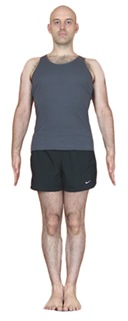
Tadasana, or Standing Pose, is the one of the most foundation pose in asana practice.  The importance of the pose became apparent when we spend two whole days teaching a roomful of adults how to stand.  We all know how to stand, right?  Tadasana is more than just standing, it is a powerful pose that engage all the muscles.  It is simultaneously grounding and lifting.  In proper alignment, there should be two lines of energy extending from the core, one down to the ground to your feet (the base) and one extending through your heart and head ascending to the stars.  Standing tall requires just enough energy to keep your body rooted, but relaxed enough so that we can be at ease and focus on the breath.  My favorite explanation is "root down to rise up."
When we learn how to stand like a mountain, we can start to see how every other pose is built on tadasana.  Every pose asks that we engage in two directions, with just the right balance between effort and ease.  Every pose has a base, which may not always be our feet.  And every pose has a lifting or opening.
As I was practicing tadasana this week, I connected the duality of the pose to what I identify as one of my core values -- that I strive to find balance in all things, yin and yang, and sometimes these may be in conflict.  I believe inner conflict can be essential for growth.  Or maybe it's not, but I think it's probably not a stretch to say that most of us have inner conflicts of beings.  The very concept of identify, I've often seen, is a conflict between wanting to express individuality and wanting to fit in, or be a part of something bigger than one's self.
Nietzsche famously said, we must have conflict within ourselves in order to give birth to dancing stars.  I interpret this beautiful aphorism to mean that we can hold conflicting ideas simultaneously and explore them, rather than fight with them or try to be right.  The key is to find how the duality of both sides resonates with your being.  What does this mean to me.  That is what I learn from tadasana and it's one of my most fundamental values -- there is no right or wrong, but there are different paths.  The path that explores both sides will be more fruitful than one that says 'only this path is the right path.'  Even if this inner struggle is subtle, it helps me to think of every challenge in this light.  Every difficultly is either an opportunity to learn and grow or a chance to step back and try a different route.  The same is true in culinary arts.  It's all about balance, folks.  How can we cook with more balance? Is it possible to maintain the base of a recipe while stepping outside what's written and try to make it rise above what's been done before?  What do we need to engage in our minds and bodies to create healthy food and where can we find comfort and ease in our diets.  Great questions to meditate on...more to come.

Monday, March 2, 2015

Taking the Teacher Training Plunge

I can barely contain my excitement for the new journey I embarked on this past weekend.  I finally began a 200-hour Yoga Teacher Training program and will be certified to teach yoga by the Summer.  This is something I have wanted to do for a long time and had been seeking the right opportunity.  My hesitation in enrolling sooner was not for lack of available teachers or programs, rather there were too many that I wanted to study with.  I am blessed to live in an area with such a vibrant yoga community with a plethora of amazing teacher.  When I heard that Honor Yoga, a new yoga studio in town was offering RYT-200 training, I felt a calling.

I did not know a lot about their program but I knew many of the teachers there and learned that the studio's owner and I had a friend in common -- who happens to be the very first yoga teacher I had in Princeton.  I came to learn that the owner of the studio and I had studied yoga with the same teacher for many years, our mutual friend, who was a major inspiration for me deepening my interest in yoga over the past 7-years.  We were students of the same teachings and shared a strong connection to the philosophy of yoga.  My difficult decision as to where to study seemed to be not so difficult at all -- the opportunity connected with my identity -- I could not wait to begin.
So here I am, only a few days into training, and I'm loving it so far.  I hope to post more regularly on the blog, not just about what I'm cooking in my kitchen but also reflecting on my deep immersion into yoga philosophy, asana, anatomy, and more.  Stay tuned for more.
All things go-
Namaste.

Tuesday, February 17, 2015

Superfood Goji Bites - Quick Energy on the Go

This weekend I did a food demo at the local Lululemon where I handed out heart-healthy whole food treats.  I was grateful for the opportunity to share food with the amazing yoga community that Lululemon helps to foster.  They offer free yoga classes in-store every week which I love going to because of the regulars who go.  Although we had freezing temperatures and gusty winds, dozens of people came by to sample treats and talk about healthy eating.  Special thanks again to the amazing workers at Lululemon and for collaborating with me.
One of the hits of my tasting was a homemade super food energy bar.  It's packed full of whole food high-energy fruits, nuts and seeds so it's perfect when you need some quick energy on the go or before/after a yoga class.
The secret to this recipe is using high quality ingredients.  Whenever possible I like use organic sprouted nuts and seeds.  To sprout raw nuts or seeds, simply soak them in 2-3x the water overnight and then drain.  This makes them more digestible and easier to blend together.  The basic method is this:

  1. Gather equal parts of your favorite nuts, seeds and dried fruits.
  2. Throw everything in a food processor.
  3. Add any additional flavorings or spices
  4. Pulse the mixture until it starts to get crumbly, scraping down the sides with a spatula as needed.  I've had the best results blending until it just starts to ball up.  Depending on the ingredients you use, you might need to add a tiny bit of liquid (I reserve the soaking water from dates or juice...lemon or orange works nice) to help get things moving.
  5. Transfer mixture to a glass baking dish lined with parchment paper and press down with the back of a spoon until it it is smooth.
  6. Let it firm up at room temperature for a bit before cutting into bars or squares.
  7. Store leftovers in the fridge for 3-4 days or in the freezer it will keep for months (though I doubt they would last that long before being eaten!)
For my super food yoga snack bars I use:
  • 1-cup sprouted raw organic cashews
  • 1-cup organic mulberries
  • 1/2-cup organic goji berries
  • 1/2-cup organic goldenberries
  • 1/4-cup pistachios 
  • 1/4-cup organic raw cacao nibs
  • 1/4-cup almond meal
  • 3-soaked dates, drained
  • dash of pink himalayan salt
  • 1-tsp cinnamon
  • 1-tsp vanilla
Remember, you can mix it up.  I'm going to continue to play with this recipe and try adding some sprouted grains for a different texture.  I sometimes like to substitute the almond meal or sprouted and dehydrated buckwheat.  I want to try adding popped amaranth seeds next time.  Feel free to comment below with the combo that you like best.  Happy snacking!

Sunday, February 8, 2015

Science-Based Strategies vs. Health Hacks -- Two Spicy Health Tidbits That Are Actually Helpful

Last summer, Rich Roll wrote a blog post railing against the hack that went viral.  It is a brilliant critique on our shortcut obsessed society, and a plea to remind us to invest in the journey and to devote time to learning how to be your best self -- "the ant-hack."  If you didn't see the article, there's now a TED-style video version.  It's a good investment of 19-minutes, likely longer than the time it would take you to read the original -- so the video is definitely not a hack, but worth watching.
As Rich points out, he was quite surprised to see his article become a meme in social media.  What's noteworthy about his post going viral is the fact that it became noteworthy and went viral.  He is basically pointing out something that should be common sense, but isn't for most of us.  This reminds me of what Michael Pollan said in an interview about his often quoted aphorism: "Eat food, mostly plants, not too much."  The fact that simple messages like these get so much attention does indeed tell us a lot about our demand for instant gratification, and how difficult it is to discover and develop helpful and sustainable behaviors and practices.

On my journey to be my best self as a plant-based yogi, I dedicate a lot of time to learning, practicing and iterating.  There are no substitutes to experience, and certainly no real "hacks" to good health or happiness.  I try to approach cooking like hiking a new trail -- generally I know the direction I want to go but I allow myself to explore and play, and sometimes fail.  Once I embarked on a hike alone, relying too much on my phone's GPS rather than looking at the trail map.  At least when a recipe is a failure, you won't need a rescue party to find your way back home. :-)  This was a great reminder that technology can and will fail, so it's important to find reliable sources of information.  This holds true especially in cooking and nutrition.  So when it comes to learning how to cook healthfully, science-based evidence can be just as important as experience.

Without further ado, I'd like to share some amazing healthy cooking strategies that are sorta like...hacks!  Are there really shortcuts to better nutrition?
Well, these do actually work according to scientific evidence.  So I think if we can boost good behaviors by learning reliable facts, then science-based tips like these deserve praise even if they sound like hacks.  Here are my two* favorite cooking hacks strategies that might actually help us optimize health -- at least for cooking with turmeric and broccoli. (*and a bonus non-time saving but health promoting tip for garlic ;-):

1)  Consuming ground pepper with turmeric boosts the effectiveness of curcumin (the anti-inflammatory, cancer-fighting, health-promoting chemical in turmeric) by 1000.  Always crack some pepper into any smoothie or dish you make with turmeric to make it even healthier.  As proof that this is not a hack, here's the science behind why this works:
Why Pepper Boosts Turmeric Blood Levels

2)  Adding just a pinch of ground mustard to cooked broccoli restores the health boosting, cancer fighting enzymes that are destroyed during cooking.  Nutrition Facts has a video on the science behind this health promoting strategy too:
Second Strategy to Cooking Broccoli

*3) Garlic Bonus strategy tip:  Remember to let your garlic rest for around 10-minutes after chopping before you cook it or use it in recipes.  Preparing garlic this way has been shown to preserve cancer-fighting and health promoting enzymes that are destroyed if cooked too soon.  WHFood's website updated their fantastic nutrition guide to include this information too.

If you give your chopped/crushed garlic time to sit before changing its temperature (through cooking) or its pH (through the addition of acidic food like lemon juice), it will give the alliinase enzymes in garlic an opportunity to work on behalf of your health. (source)

So maybe taking a tiny bit more time or adding a dash of spice -- rather than seeking shortcuts -- is the real health hack ;-)  Peace, plants.  Namaste.

Thursday, February 5, 2015

When it Comes to Food, Are We Human Beings vs. Human Doings?

The Kundalini  master, Yogi Bhajan used to say, “We’re human Beings, not human Doings.”  In modern life, how many of us take the time to stop doing and be?   We cling to our routines and have endless distractions at our fingertips -- so much that it's beginning to change our brains.  In yoga, we remind ourselves to pause, not to tune out but to tune in to what we are, to the present...to be.  This theme of returning to our nature is found throughout yoga philosophy, and also in modern discourse on food.  It becomes increasingly difficult to be present with our food when we are so removed from its creation or its source.
When we learn where our food comes from, how it is grown, cultivated, prepared and cooked, we make the connection between food and our being.  Study after study has shown the single most predictive indicator of good health is whether or not we cook for ourselves.  Preparing our food consciously leads us to make better choices.  It really is as simple as 'we are what we eat.'  
In cooking, of course there is much to do, as with yoga.  The doing is to prepare and to practice.  One of most basic lessons I learned in chef school is to prepare the mise-en-place.  This is the French term for everything in its place, or prepping, measuring, chopping all of your ingredients and setting up your space.  This simple act of preparing is so essential because it allows us to be present when we're ready to create.  We don't need to hunt down that ingredient or worry about our ratios when everything is in its place.  Mise-en-place, like the practice of asana yoga is never the goal.  They are doings of preparation so that we can be (the goal or intention).  Too often we allow ourselves to get so caught up in the doing, we forget that it is all practice to get to the being.  We tell ourselves the story that we don't have time to cook.  Studies have shown that on average we spend far less time today in the kitchens preparing food than past generations.  Is it that we really don't have time to cook, or is it that we don't make it a priority?  I recognize it can be difficult, because most of us are not taught how to practice the art of time management in the kitchen.  I never understood the value of mise-en-place until I went to culinary school.  It was daunting, at first, because it was new and it took a lot of time.  I wanted to dive right in but I didn't realize that it takes practice to be well prepared to be a cook.  The more I chopped veggies, the better I became at knife skills.  It used to take me several minutes to prep an onion, now I can finely mince one without crying.  Anyone can learn, even without going to school.  As with yoga, everything takes practice.
We are lucky that we live in the age of information and can find out how to do almost anything through youtube how-to's or blogs.  This morning I heard an encouraging story about new classes on cooking as part of a college curriculum.  The wonderful thing about practicing with others or as part of school is that it helps build confidence and makes it easier to practice.
Even if you think you don't have time to prepare something, challenge yourself to find something simple you can practice that will help you be present with your food.  For some, this could be being a more health conscious shopper rather than a more skilled chef (e.g. watch this great 'how to navigate the supermarket' with Michael Pollan).  There is no one path that leads to being present.  Any form of practice will help us find our mental mise-en-place.