Thursday, December 10, 2015

Do We Want to Know How Our Food is Made?

Earlier this week, I listened to a special report on food production and food safety.

Farm to Fork: Uncovering Hazards in Our Food Systems


I found this special report fascinating. It's all about the process of how food ends up on our plates (which a big portion is dedicated to meat production). What's more fascinating is that I'd bet that most meat eaters will have no interest in listening to this. "I don't want to know [what happened to this animal before it got to my plate]" For the food I now eat, I'm continuously fascinated by and eager to learn more about how plant based food is produced, harvested and distributed. Doesn't that reveal something about it if we want to willingly remain in the dark about the food we put in our bodies and feed our families with?

Hopefully this popular mindset is changing. More people are getting interested in particular parts of the story about how food is made. There are growing concerns about local, organic, and GMOs. Most importantly, this special report also focuses on the workers who make this whole process possible. There are so many abuses in our food system and parallels between the exploitation of animals and people caught in the middle. The way our food is made today neglects fundamental human and animal rights.

We can make the companies that produce our food change. We make a difference every day by voting with our dollars. As much as we tend to villainize big corporations, I believe they will necessarily be part of the solution...if we make them change.

"At the center of these complex systems [all the various ways food gets to us] is people. There is stark contrast between the condition of the foods we see in grocery stores and the conditions the workers ensure to put it there. But change is possible."

Wednesday, December 9, 2015

Climate Talks and Walking the Walks

This week world leaders have gathered in Paris for the COP21 to discuss solutions for the climate crisis we're in.  I've been reading news accounts about protests outside the convention where activists are urging leaders to recognize the effects of raising and killing animals for food on our environment.  It's been years since the famous UN FAO report tallied up the causes of climate change and found that the animal food industry is the largest contributor to greenhouse gases, species extinction, land use, deforestation, water use, and waste - by a large margin.  On just greenhouse gases alone, they account for more than 18% which is more than every car, truck and airplane on the planet.

I do think we need leadership on a global scale, but I am less hopeful that this will be the message from the COP21 talks.  The good news is that people are catching on.  Movies like Cowspiracy are helping to shine a light on the elephant in the room.

This was a big year for veganism hitting the mainstream conscious.  This week we saw a great example:  I may not agree with Arnold Schwarzenegger on many things but he does know a lot about bodybuilding, and now even he says A) we don't need meat to build muscle and B) we'd all be better off if we ate less meat.

You don't need meat to grow strong and heathy
"Luckily we know that you can get your protein from many different ways. You can get it from vegetables; I have seen many bodybuilders and lifters that are vegetarian and get strong and healthy and many who eat meat who get strong and healthy." - Arnold Schwarzenegger.One protein source feels pain and is linked to the increased risk of many diseases, and has awful environmental consequences, the other protein source (plants) does not... It's an easy choice.
Posted by Vegan Bodybuilding, Health and Nutrition on Tuesday, December 8, 2015


Tuesday, December 8, 2015

Green Bananas As a Cashew Substitute?

I have to try this.  Apparently you can use cooked green bananas to replace cashews in many recipes. Cook them in the Instant Pot and freeze the biomass.  Method from UC Davis
UC DAVIS
Integrative Medicine Program

Monday, December 7, 2015

The Roots of Hanukkah and a Root Vegetable Latke Recipe

Happy Hanukkah! To celebrate the "Festival of Lights," we're encouraged to put candles on display for all to see. But did you know the meaning of the word Hanukkah means dedication?

I like to celebrate by thinking about those who need a little more light in their life. Even if we're not lighting candles, we can share our inner light with everyone. We can help light the way for others who may have lost their way in darkness. Whenever we say "namaste," we're making a dedication to share our love, light and compassion that we all have within us. While I may not be religious,I see the major winter holidays like Hanukkah, Kwanza and Christmas are all rooted in this message of sharing our light. Perhaps that's why so many decorate their homes with lights...on the outside!

So when I see a house covered in Christmas lights, windows filled with brightly lit menorahs, or lavishly decorated trees, I don't view them as reminders to shop and buy things we don't need. All I see are reminders of how we can bring more light and color into the world.

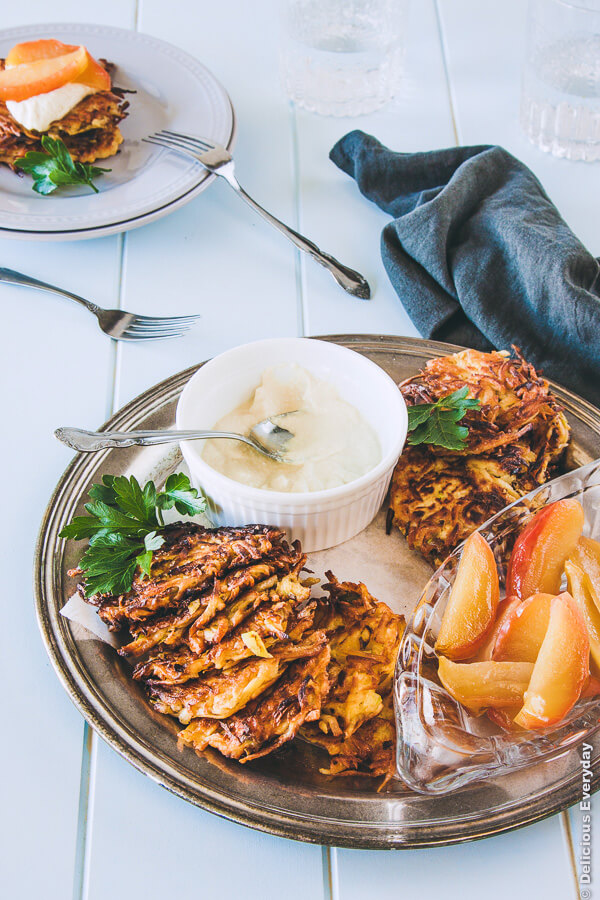
And in the spirit of the root of Hannukah...I'm excited to try this root vegetable take on vegan latkes! :) Looks delicious!!! I will try baking these without oil: From Delicious Everyday: Parsnip Latkes with Mustard Cashew Cream and Honey Roasted Apples


Wednesday, August 19, 2015

Reflections on Plant-Based vs. Vegan

After spending an incredible weekend at this year's Farm Sanctuary Hoedown​, I find myself thinking a lot about vegan vs. plant-based, but mostly about how I can share and inspire deeper connections with all beings.
Eating plant-based is unquestionably a win for our own health and the well-being of animals and the environment but the label can also cause confusion.  More and more people are eating "mostly plant-based" (which is great!) but are not committed to being vegan.  To many, eating plant-based is about a strong commitment to eating plants for health, and that's something we should embrace -- but it can be confusing as it leaves the door open to recidivism and clinging to values that are in conflict.  Here's an example I read in Philly Magazine recently:

I applaud the author of this article for writing about being (mostly) plant-based and hope that vegans refrain from criticizing anyone on this path.  It's the same path I took, which eventually made me realize the confusion I felt was inner conflict of my ego -- a tension between the values I wanted to live and the actions whereby I allowed myself to find comfort in old habits.  Making the leap to being vegan freed me from this inner conflict and helped me live in alignment with the values I already had.  It felt so liberating, and continues to deepen my connection and compassion to all life.  My intention is to help others find this connection too -- whether that means going plant-based, or even just plant-curious, it's still one of the most powerful compassionate steps you can take on the path of life.

Monday, July 6, 2015

Fourth of July Reflections on Food, Health, and Justice for All

Virtually all of the most significant societal challenges we face are linked to food.  We can't talk about improving food without talking about improving social justice.  With so much disagreement in policy and politics, food might be the one issue that can unite our country to lead changes on a global scale.  Don't we all want better education, health, communication, safety, more equality, innovation, and opportunity, less crime, pollution and waste?

Brian Lehrer recently sat down with NY Times columnist Mark Bittman for a conversation about the links between food and issues of social justice, economics and health.  Bittman has been writing about these issues for a while and offers many insights into how we can set aside our differences and make progress toward our shared goals.


As I reflect on my love for this great country and acknowledge the progress we're making on major issues, I'm feeling more confident that we can continue to help change toward a more sustainable future for all.  To all those who changemakers and peaceweavers, or anyone who has struggled and persevered, thank you and keep shining.  #HappyFourth

Thursday, May 28, 2015

Don't Believe the Hype - How a Prank Fooled Millions into Believing Bogus Science

A journalist recently put together a prank as a way to test the reception of wild claims about diet based on faulty science.  The story behind the prank can be found here.  He registered a website, crafted a completely flawed study and boasted wild claims...and the media bought into it big time.  This prank highlights some of the fundamental problems with nutrition science and reporting on it.  Far too many people believe that the science wavers back and forth: eggs are bad, eggs are good, butter is back, saturated fat is bad, high cholesterol isn't as dangerous as we thought, etc.  But this is not the case.  Nutrition science is a lot like climate science.  If it snows in April, that does not mean global warming is no longer happening.  Media outfits, websites and social media LOVE to publish stories that give us what we want to hear, especially if it's good news about bad habits.
Real reporting on science is usually boring and nuanced, big shifts in thinking about nutrition science happen gradually and slowly.  Everything has to be taken in context of the big picture.  We used to rely on respectable newspapers and magazine to filter the news.  These days, it's far too easy to get duped by bogus claims because the media (and social media) has become a mirror for repeating, retweeting, and spinning junk science.  It's up to us to be more discerning about what we read, hear and watch.  We can be yogic about our news, the same way we become inquisitive when we practice on our mats.  We can use the yamas and niyamas to help us.
What is the intention behind this news story?
Does the information help bring us into balance?
Is this excessive?
Is this committed to the truth?
Does this information promote attachment to things we know are unhealthful?
Is this a misappropriation of science?
Does the news elevate our consciousness?